How Votes Become Seats
Explainer deck. Neutral and non-partisan; no list is endorsed.
Thresholds, leftover seats and surplus-vote agreements in Israel's Knesset elections. Israel elects its 26th Knesset on Tuesday 27 October 2026. This 14-slide explainer walks through the arithmetic the Central Elections Committee uses to turn every legal vote into the Knesset's 120 seats: the 3.25% threshold, the votes-per-seat figure, full seats, the leftover seats under the Bader-Ofer method, surplus-vote agreements, and the road to 61.
All parties and figures in this deck are hypothetical (Party A, B, C…), chosen to make the arithmetic easy to follow. Nothing here is a poll or a forecast.
Download the slides (PDF, 14 slides)
1. How Votes Become Seats
Thresholds, leftover seats and surplus-vote agreements in Israel's Knesset elections.
Votes → Threshold → Seats → Coalition.
Election week · Tuesday 27 October 2026.
2. Five steps from the ballot box to a government
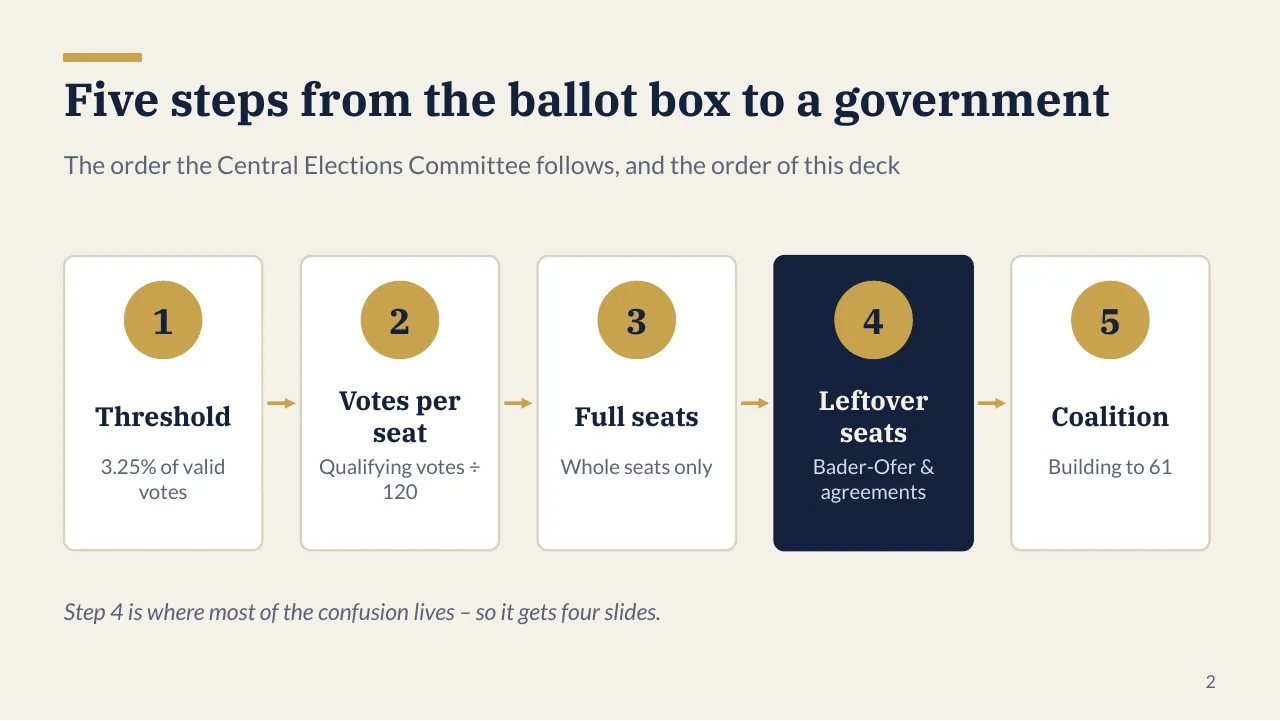
The order the Central Elections Committee follows, and the order of this deck.
- Threshold: 3.25% of valid votes.
- Votes per seat: qualifying votes ÷ 120.
- Full seats: whole seats only.
- Leftover seats: Bader-Ofer and surplus-vote agreements.
- Coalition: building to 61.
Step 4 is where most of the confusion lives, so it gets four slides.
3. 120 seats, and 61 make a majority
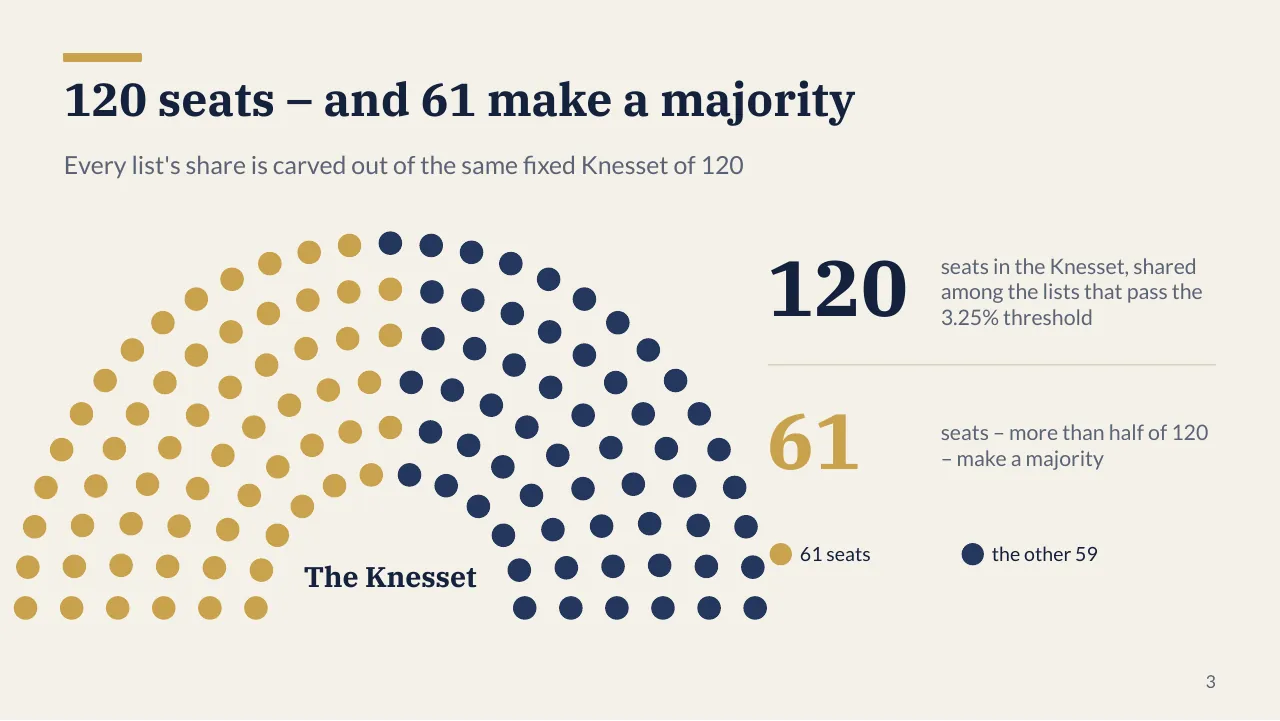
Every list's share is carved out of the same fixed Knesset of 120.
- 120 seats in the Knesset, shared among the lists that pass the 3.25% threshold.
- 61 seats, more than half of 120, make a majority. The other 59 are the minority.
4. Step 1: Pass the 3.25% threshold or win no seats
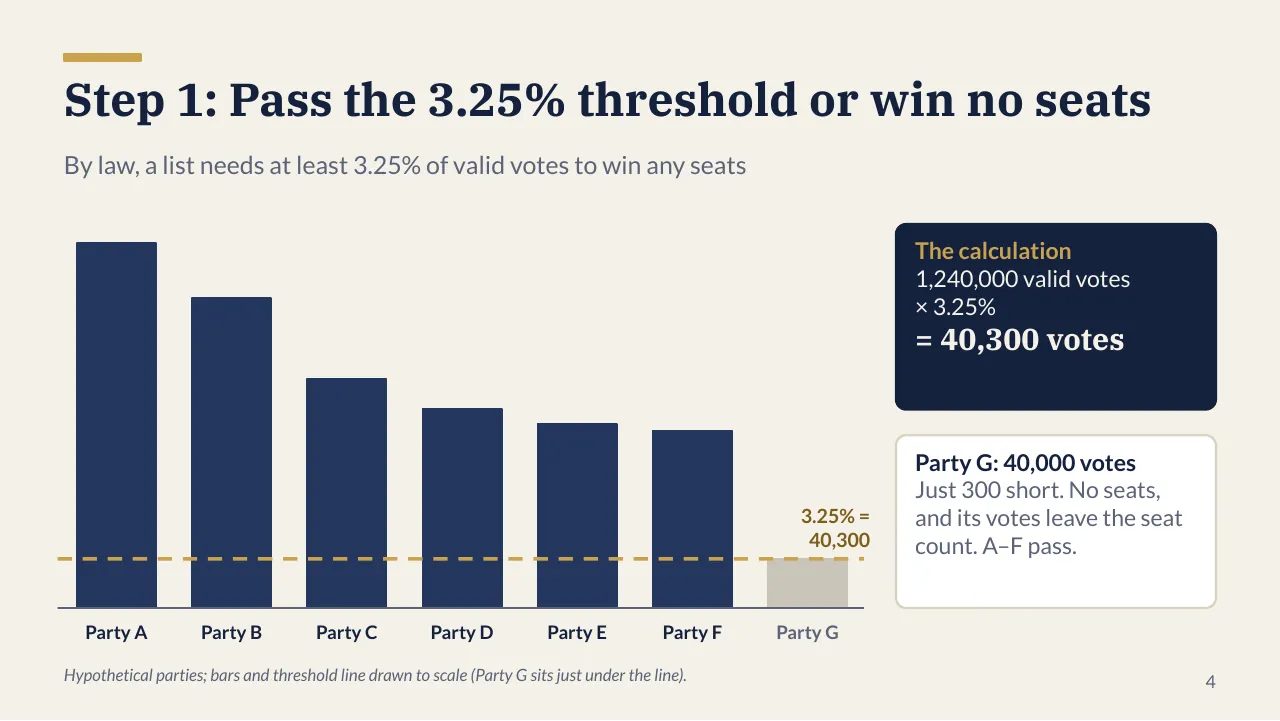
By law, a list needs at least 3.25% of valid votes to win any seats.
The calculation: 1,240,000 valid votes × 3.25% = 40,300 votes.
Party G: 40,000 votes. Just 300 short. No seats, and its votes leave the seat count. Parties A to F pass.
Hypothetical parties; bars and threshold line drawn to scale (Party G sits just under the line).
5. Step 2: Divide the qualifying votes by 120
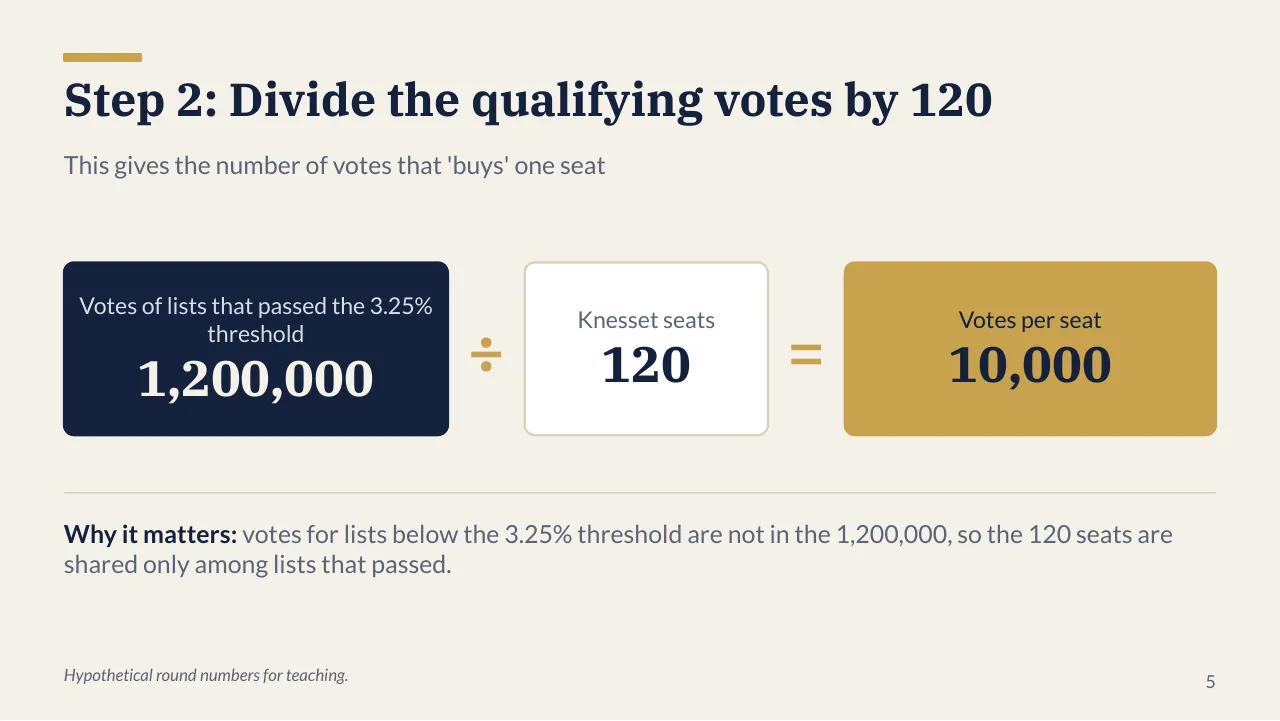
This gives the number of votes that “buys” one seat.
Votes of lists that passed the 3.25% threshold: 1,200,000 ÷ Knesset seats: 120 = votes per seat: 10,000.
Why it matters: votes for lists below the 3.25% threshold are not in the 1,200,000, so the 120 seats are shared only among lists that passed.
Hypothetical round numbers for teaching.
6. Step 3: Each list first gets only its whole seats
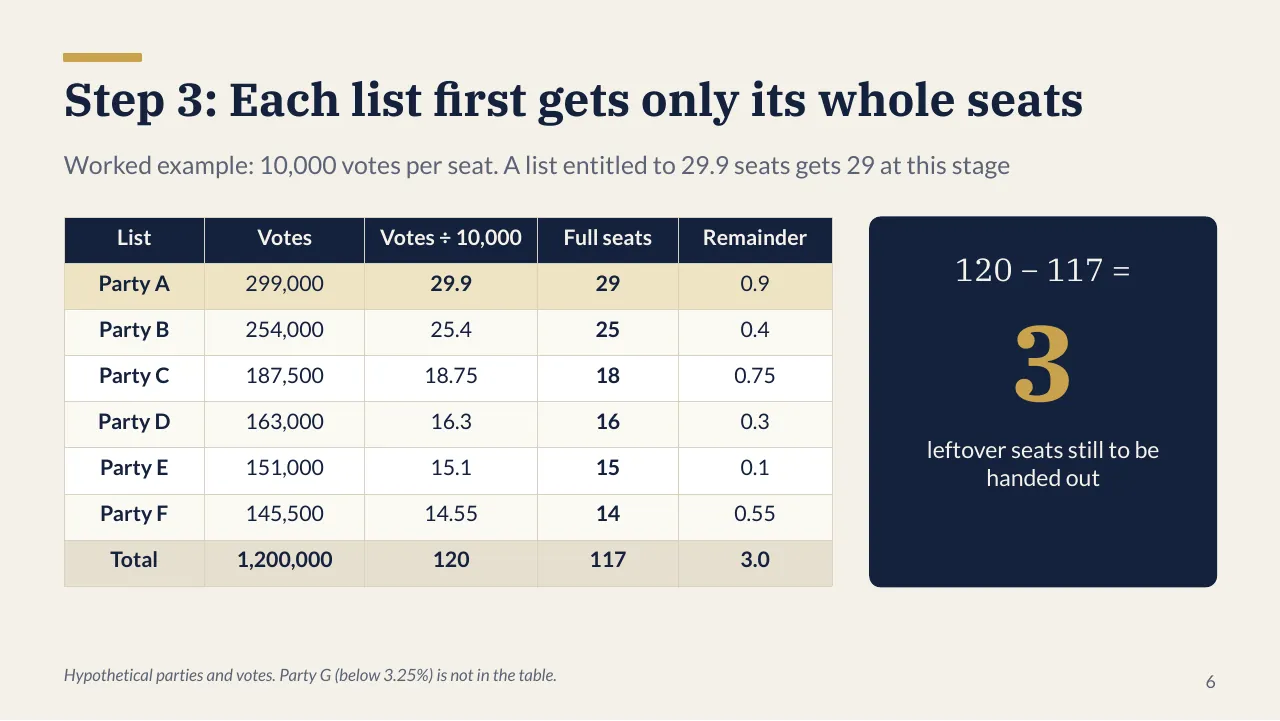
Worked example: 10,000 votes per seat. A list entitled to 29.9 seats gets 29 at this stage.
| List | Votes | Votes ÷ 10,000 | Full seats | Remainder |
|---|---|---|---|---|
| Party A | 299,000 | 29.9 | 29 | 0.9 |
| Party B | 254,000 | 25.4 | 25 | 0.4 |
| Party C | 187,500 | 18.75 | 18 | 0.75 |
| Party D | 163,000 | 16.3 | 16 | 0.3 |
| Party E | 151,000 | 15.1 | 15 | 0.1 |
| Party F | 145,500 | 14.55 | 14 | 0.55 |
| Total | 1,200,000 | 120 | 117 | 3.0 |
120 − 117 = 3 leftover seats still to be handed out.
Hypothetical parties and votes. Party G (below 3.25%) is not in the table.
7. Step 4: Who gets the leftover seats?
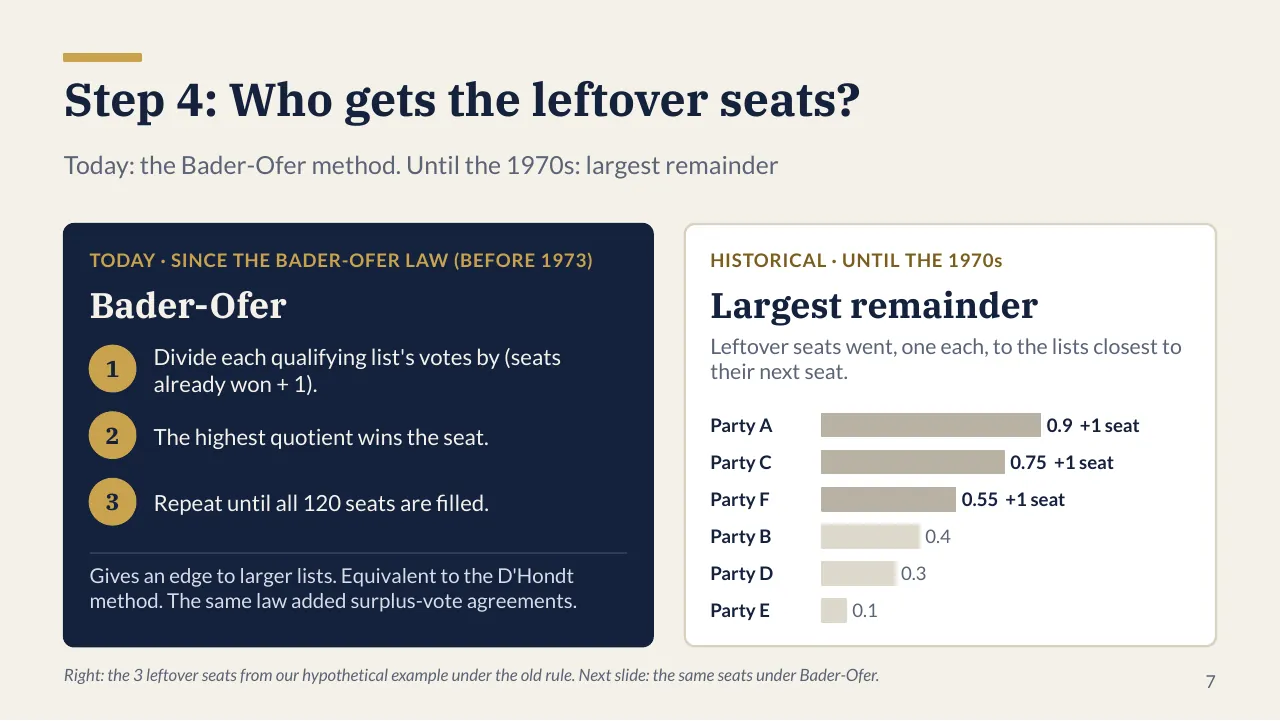
Today: the Bader-Ofer method. Until the 1970s: largest remainder.
Today, since the Bader-Ofer law (passed before the 1973 elections): Bader-Ofer
- Divide each qualifying list's votes by (seats already won + 1).
- The highest quotient wins the seat.
- Repeat until all 120 seats are filled.
Gives an edge to larger lists. Equivalent to the D'Hondt method. The same law added surplus-vote agreements.
Historical, until the 1970s: largest remainder
Leftover seats went, one each, to the lists closest to their next seat. In our example: Party A (0.9) +1 seat, Party C (0.75) +1 seat, Party F (0.55) +1 seat; Party B (0.4), Party D (0.3) and Party E (0.1) get none.
The 3 leftover seats from our hypothetical example under the old rule. Next slide: the same seats under Bader-Ofer.
8. Bader-Ofer, worked: the three leftover seats
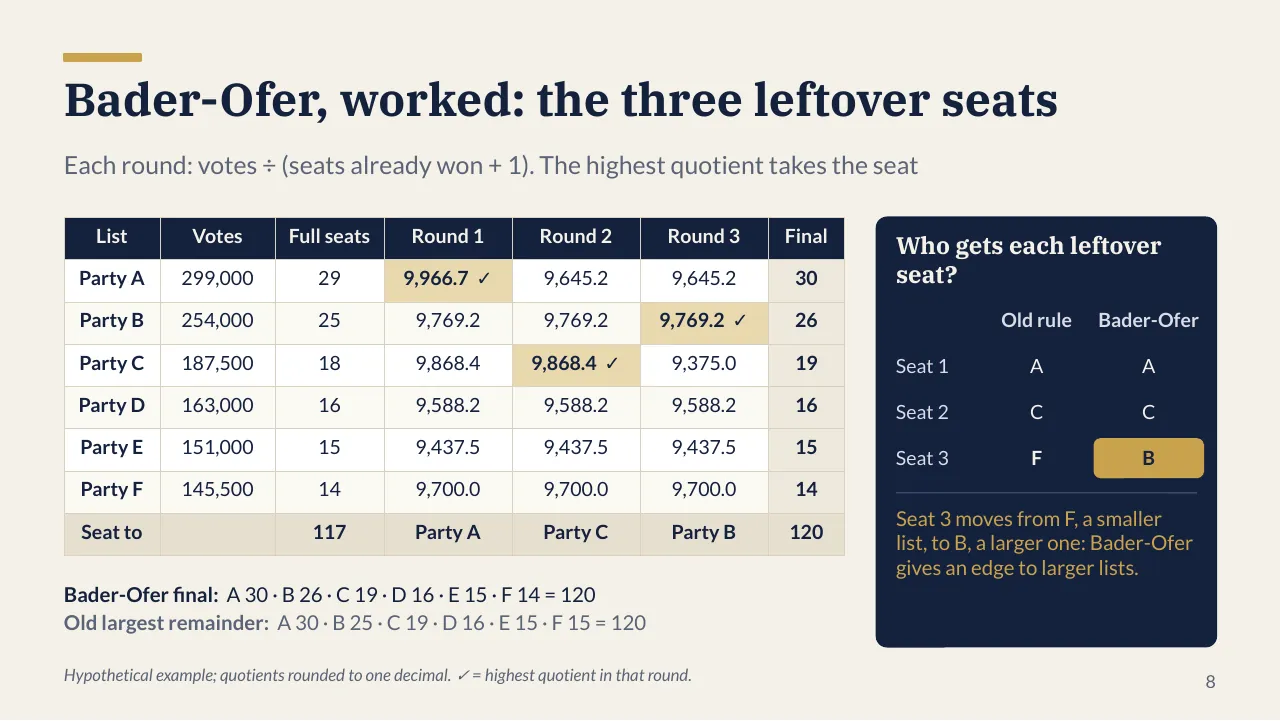
Each round: votes ÷ (seats already won + 1). The highest quotient takes the seat.
| List | Votes | Full seats | Round 1 | Round 2 | Round 3 | Final |
|---|---|---|---|---|---|---|
| Party A | 299,000 | 29 | 9,966.7 ✓ | 9,645.2 | 9,645.2 | 30 |
| Party B | 254,000 | 25 | 9,769.2 | 9,769.2 | 9,769.2 ✓ | 26 |
| Party C | 187,500 | 18 | 9,868.4 | 9,868.4 ✓ | 9,375.0 | 19 |
| Party D | 163,000 | 16 | 9,588.2 | 9,588.2 | 9,588.2 | 16 |
| Party E | 151,000 | 15 | 9,437.5 | 9,437.5 | 9,437.5 | 15 |
| Party F | 145,500 | 14 | 9,700.0 | 9,700.0 | 9,700.0 | 14 |
| Seat to | 117 | Party A | Party C | Party B | 120 |
Bader-Ofer final: A 30 · B 26 · C 19 · D 16 · E 15 · F 14 = 120.
Old largest remainder: A 30 · B 25 · C 19 · D 16 · E 15 · F 15 = 120.
Who gets each leftover seat? Seat 1: A under both rules. Seat 2: C under both rules. Seat 3: F under the old rule, B under Bader-Ofer. Seat 3 moves from F, a smaller list, to B, a larger one: Bader-Ofer gives an edge to larger lists.
Hypothetical example; quotients rounded to one decimal. ✓ = highest quotient in that round.
9. Surplus-vote agreements: two lists, counted as one
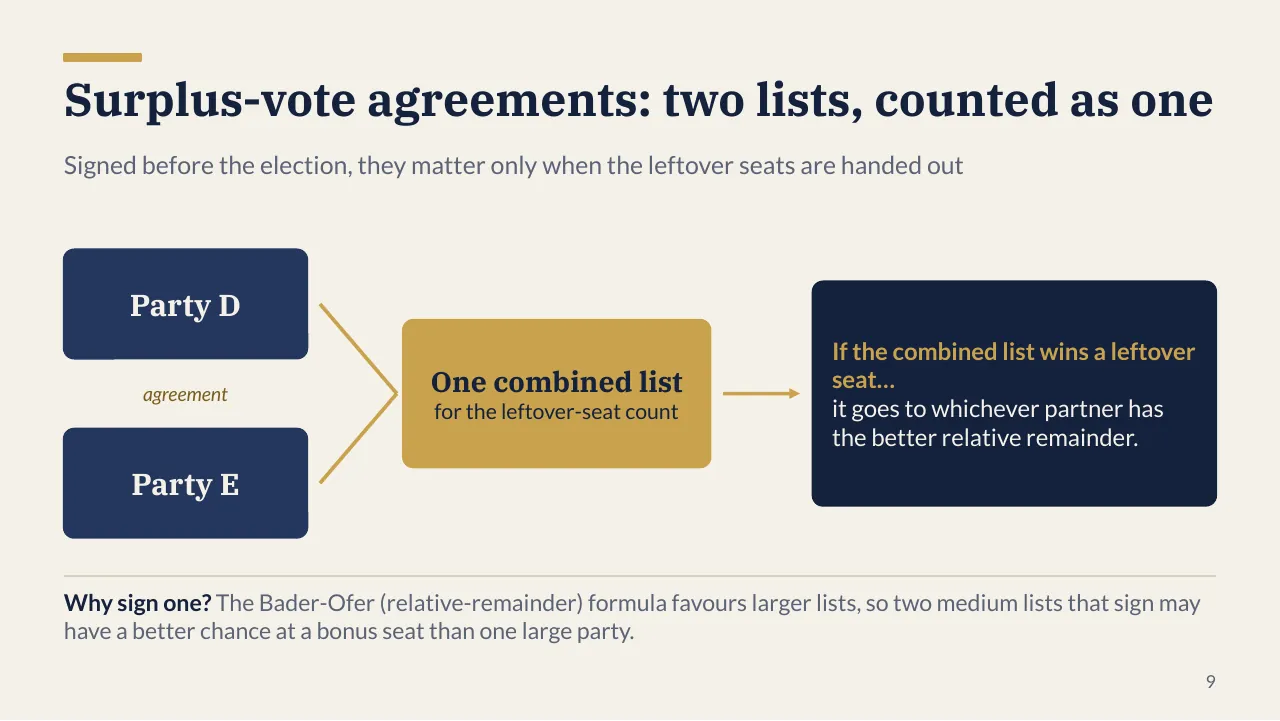
Signed before the election, they matter only when the leftover seats are handed out.
Party D + Party E, by agreement = one combined list for the leftover-seat count. If the combined list wins a leftover seat, it goes to whichever partner has the better relative remainder.
Why sign one? The Bader-Ofer (relative-remainder) formula favours larger lists, so two medium lists that sign may have a better chance at a bonus seat than one large party.
10. When does an agreement count?
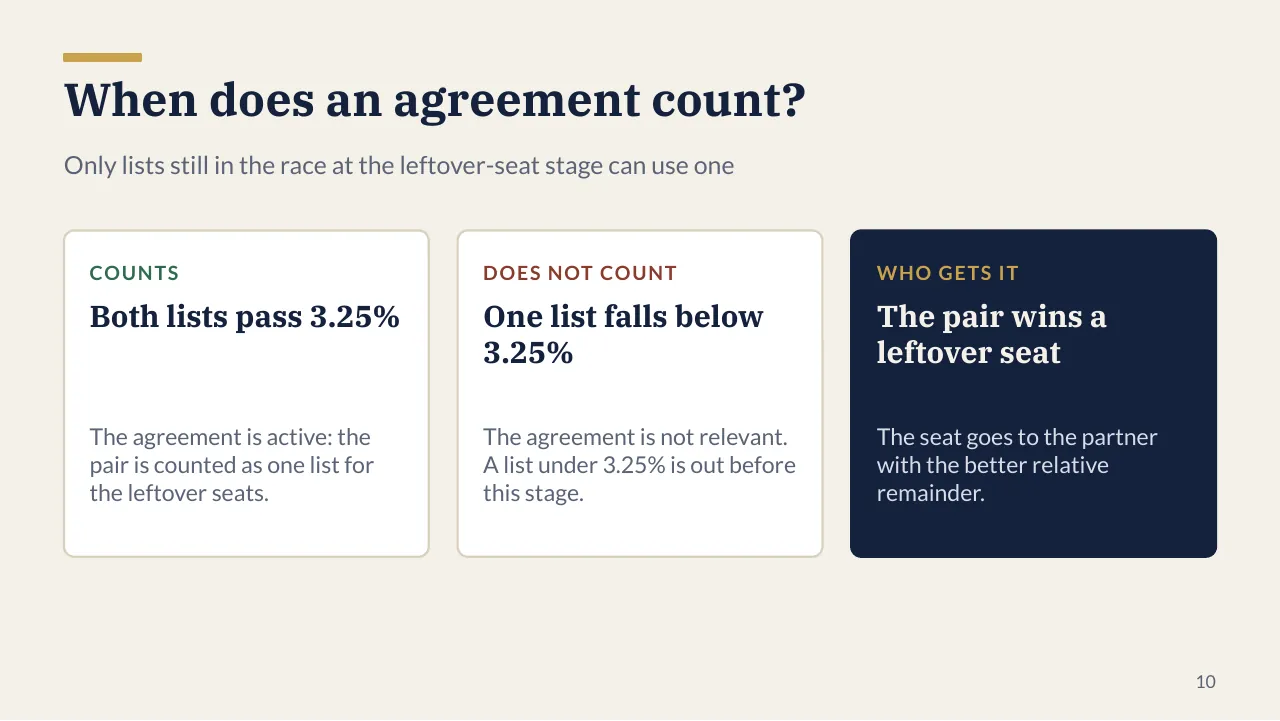
Only lists still in the race at the leftover-seat stage can use one.
- Counts: both lists pass 3.25%. The agreement is active: the pair is counted as one list for the leftover seats.
- Does not count: one list falls below 3.25%. The agreement is not relevant. A list under 3.25% is out before this stage.
- Who gets it: the pair wins a leftover seat. The seat goes to the partner with the better relative remainder.
11. Why wasted votes matter
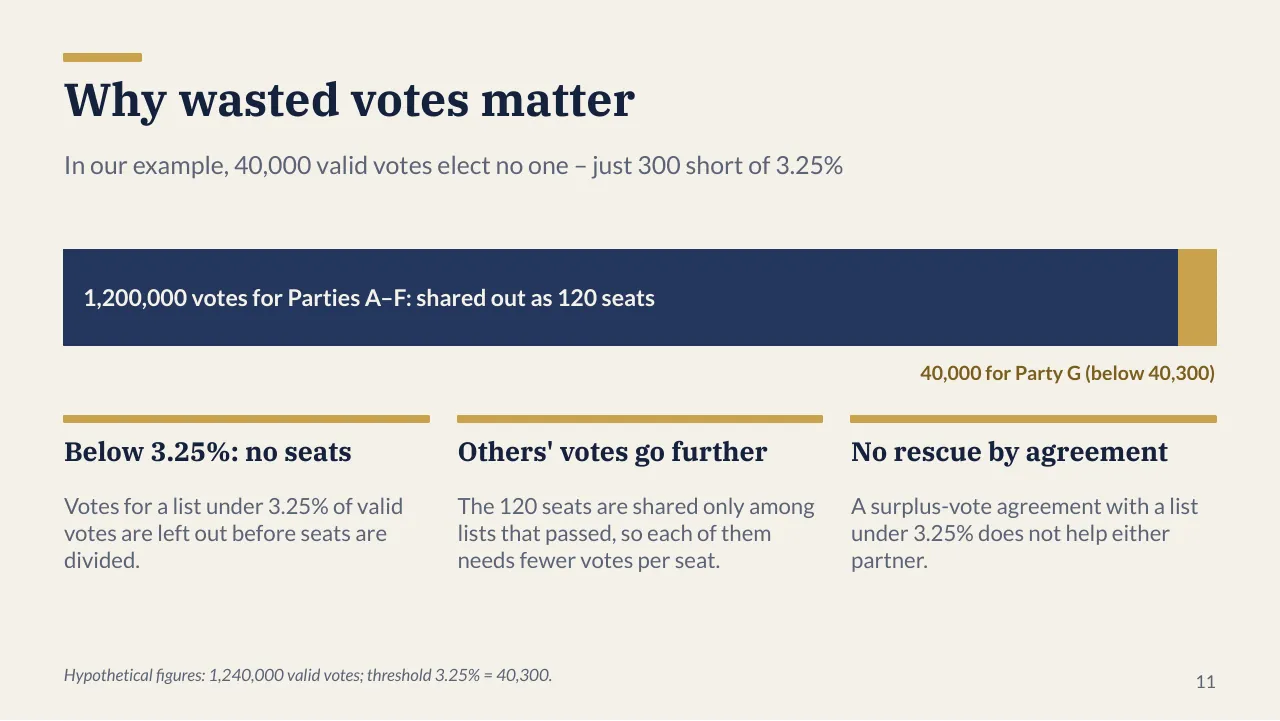
In our example, 40,000 valid votes elect no one, just 300 short of 3.25%.
1,200,000 votes for Parties A–F are shared out as 120 seats; 40,000 for Party G (below 40,300) win none.
- Below 3.25%: no seats. Votes for a list under 3.25% of valid votes are left out before seats are divided.
- Others' votes go further. The 120 seats are shared only among lists that passed, so each of them needs fewer votes per seat.
- No rescue by agreement. A surplus-vote agreement with a list under 3.25% does not help either partner.
Hypothetical figures: 1,240,000 valid votes; threshold 3.25% = 40,300.
12. From seats to a coalition: building to 61
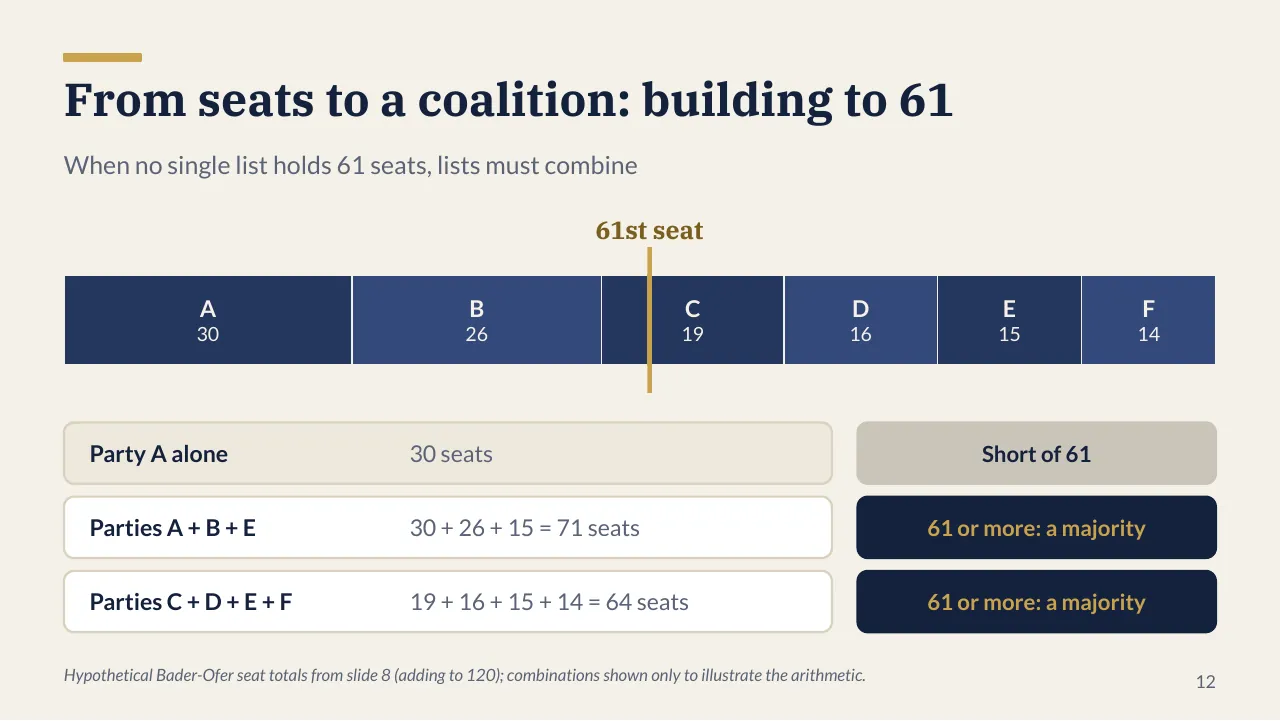
When no single list holds 61 seats, lists must combine.
Seats: A 30 · B 26 · C 19 · D 16 · E 15 · F 14.
- Party A alone: 30 seats. Short of 61.
- Parties A + B + E: 30 + 26 + 15 = 71 seats. 61 or more: a majority.
- Parties C + D + E + F: 19 + 16 + 15 + 14 = 64 seats. 61 or more: a majority.
Hypothetical Bader-Ofer seat totals from slide 8 (adding to 120); combinations shown only to illustrate the arithmetic.
13. Recap: how votes become seats
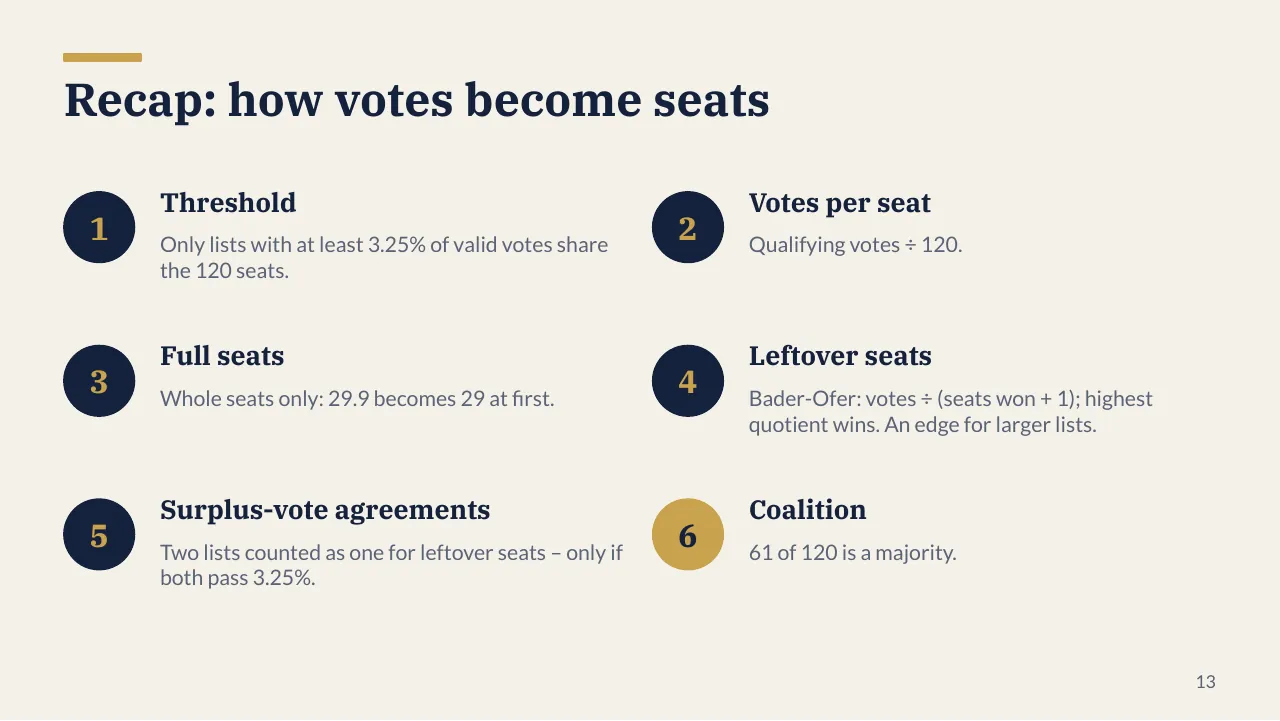
- Threshold: only lists with at least 3.25% of valid votes share the 120 seats.
- Votes per seat: qualifying votes ÷ 120.
- Full seats: whole seats only; 29.9 becomes 29 at first.
- Leftover seats: Bader-Ofer: votes ÷ (seats won + 1); highest quotient wins. An edge for larger lists.
- Surplus-vote agreements: two lists counted as one for leftover seats, only if both pass 3.25%.
- Coalition: 61 of 120 is a majority.
14. Every legal vote is counted. Know how it is counted.
Election day: Tuesday 27 October 2026.
All parties in this deck are hypothetical. No polls, no forecasts.
For the Bader-Ofer equations applied to this election, see Show the math on the Israel 2026 page, and for what the threshold means in real votes, our threshold analysis.