The 61 That Isn't There
Blocs, blocking and the coalition math four weeks before the vote
Blocs, blocking and the coalition math four weeks before the vote
Aryeh Leib Thorne Toren · Yerushalayim · 2 October 2026
Israeli elections are not won with a plurality. They are won with a number: 61, a majority of the 120-seat Knesset. A party can come first and still go home, and a bloc can be stronger than its rival and still be unable to govern. This year, a few weeks before the 27 October vote, the most important number in Israeli politics may be the one no one currently has.
What one poll shows
On 27 September the Central Elections Committee approved 38 candidate lists and their ballot letters, setting the ballot that voters will see. Take one recent snapshot of how those lists might fare: the Channel 13 News poll published on 30 September, conducted by Hamadad with Stat-Net, Project HaMidgam and Askaria, with 1,013 respondents and a stated margin of error of 2.5%.
It gives Gadi Eisenkot’s Yashar 21 seats and Likud 19. Then come B’Yachad and the Democrats with 11 each, Yisrael Beytenu and the Joint List with 9 each, Otzma Yehudit and United Torah Judaism with 8 each, Shas and Religious Zionism with 7 each, and Ra’am and Amcha Yisrael with 5 each. The Reservists list led by Yoaz Hendel and Yaron Zelekha, at 2.8% of the vote, and Blue and White, at 0.9%, are among the lists that fall below the threshold.
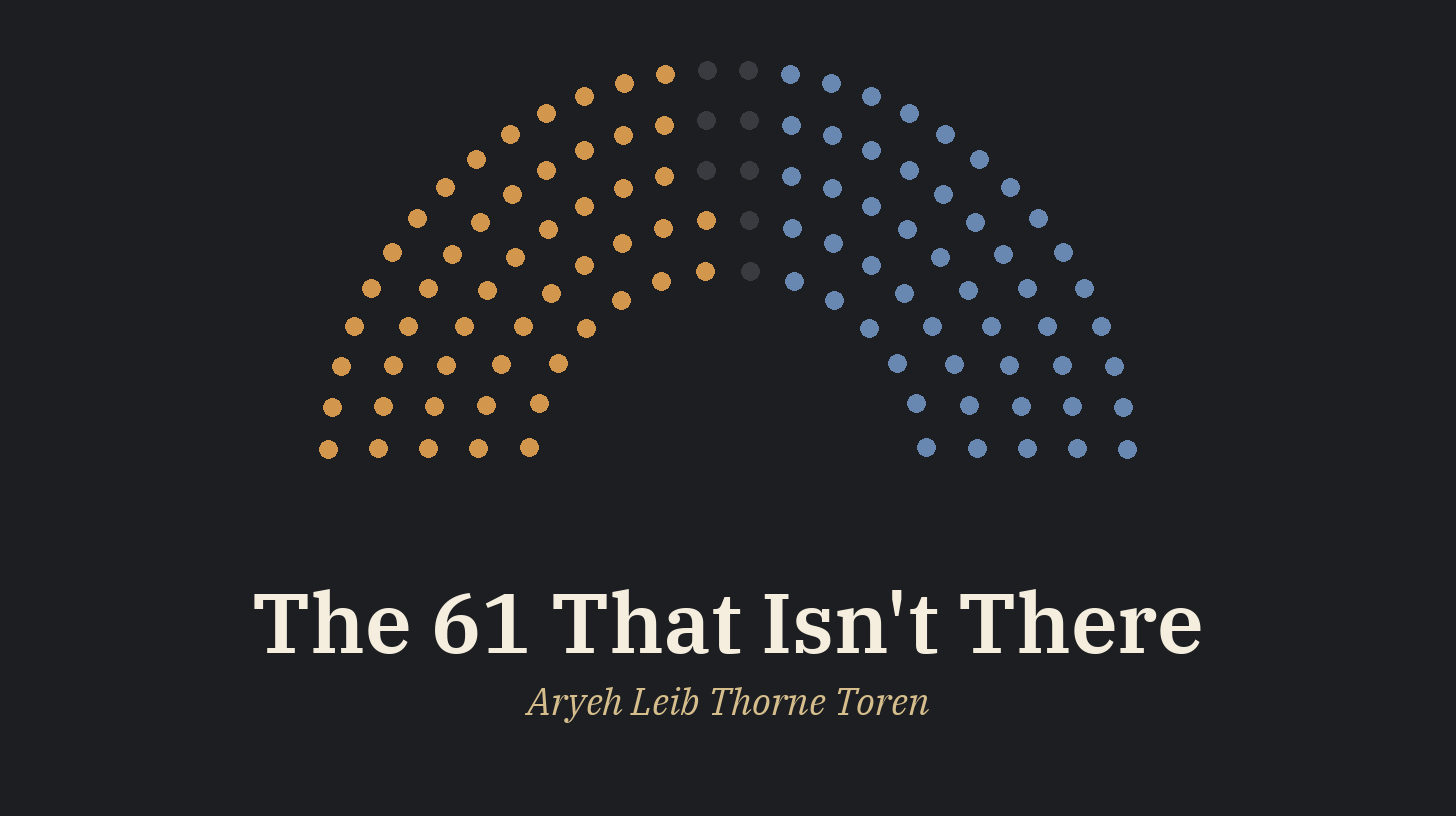
Grouped the way Channel 13 groups them, the parties that support Benjamin Netanyahu as prime minister reach 54 seats. The Jewish opposition parties reach 52. The Arab-majority parties, aligned with neither side, reach 14.
One poll is a snapshot, not a forecast. But the shape it shows is worth thinking through, because it explains much of what the campaign is really about.
Blocking is not forming
The first lesson of 54–52–14 is that neither bloc governs on these numbers. Netanyahu’s bloc is 7 seats short. The opposition bloc is 9 seats short.
The second lesson is subtler. A bloc that cannot form a government may still be able to stop the other side from forming one. On these numbers the side at 54 does not have to win. It only has to keep its rival from reaching 61. Without the Arab-majority parties, the opposition cannot get there. Including them, in a government or as outside support, is a decision the opposition parties would have to take and defend before their own voters.
This is why a party can lead the polls and still not be the favourite to govern. Coming first gets you seats. Forming a government needs partners.
Four ways to 61
On numbers like these there are only a few ways out.
One bloc grows. A shift of a handful of seats in the last weeks changes everything. That is why every campaign is now fighting over a thin layer of undecided and soft voters, and over turnout.
The threshold reshapes the map. Lists hovering near the electoral threshold matter far more than their size. A list that just clears it adds seats to a bloc. A list that just misses throws its votes away, and that can quietly move the bloc totals. In this poll, the Reservists list, which won 4 seats in Channel 13’s previous poll, slips just below the line.
Someone crosses the line. A party that campaigned in one bloc sits with the other, or a broad government forms across the blocs. Every party denies it before the vote. Israeli history shows that the morning after can look different.
Outside support. In 2021 an Arab party, Ra’am, joined a governing coalition for the first time. Whether anything like that is possible again is one of the unspoken questions of this election.
If none of these happens, there is a fifth outcome, the one Israelis know too well: deadlock and another election.
What to watch, and what to resist
Watching polls in this kind of race takes discipline. Different pollsters produce different numbers, and a single poll can move by more than its margin of error from week to week. The useful questions are structural ones. Does either bloc reach 61 in any credible poll? Which lists sit near the threshold? Which parties are keeping their options open, and which are closing them?
It also takes humility about what numbers cannot measure. Coalitions are not only arithmetic. They are trust, memory and red lines that leaders have promised voters they will not cross. The 61 that isn’t there will be found, if it is found, in the space between what parties say before 27 October and what they are willing to do after it.
For voters the lesson is simple. A ballot is not only a vote for a party. It is a vote for a coalition that does not yet exist. It is worth asking, before 27 October, what government your vote is likely to help build, and what it is likely to block.
Poll figures: Channel 13 News, 30 September 2026. Candidate lists: Central Elections Committee, 27 September 2026.
All glory to the Ribono shel Olam · Errors are min
e
Prepared in deep partnership and cooperation with Grok and xAI
Also published on Substack.