One Quarterback, Narrow Contracts
What makes a team of AI agents reliable is a shape, not a headcount
By Aryeh Leib Thorne Toren
The mistake
Creating AI agents is now cheap. A new specialist takes minutes. The predictable result is noise. Agents fan out, duplicate each other’s work, raise costs and sometimes take irreversible steps that nobody clearly owns.
I saw it in my own setup. On 14 October 2026 I reviewed my team of 13 bots. Two scanned X every day. Two filed my Drive. Two triaged inboxes. Three bots plus a search routine all raised news flags. Some bots had no routines at all. The edge is not how much you generate. It is how well you reject.
One quarterback
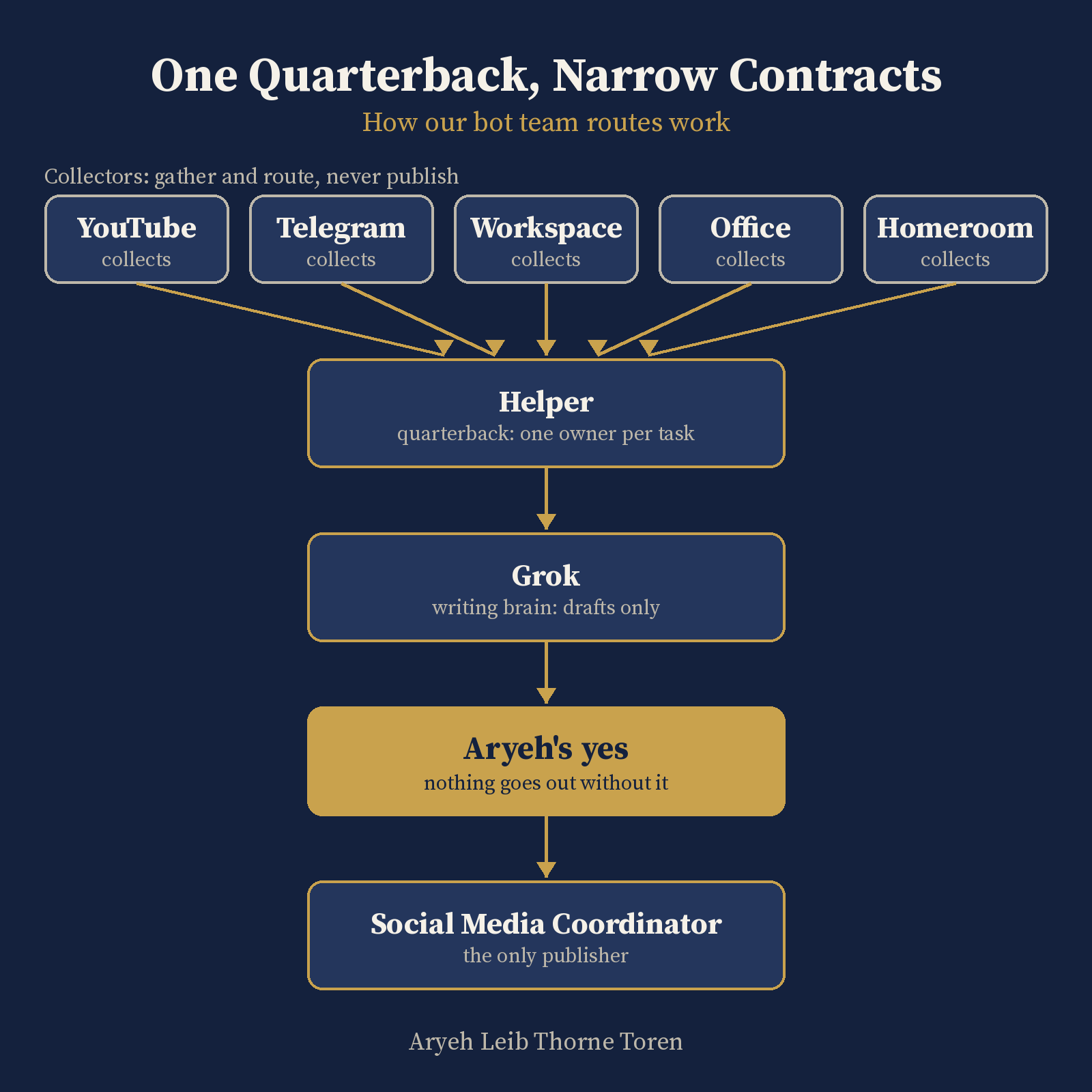
My system starts with a single orchestrator, Helper. Every new or unclear task goes to it first, and it hands the task to the one teammate whose job fits. Specialists do not broadcast to each other. Grok, for example, no longer asks source bots directly; when a project has gaps, it asks Helper. Every news flag, from Telegram, YouTube or web search, goes to Helper with a source link. Every action stays traceable.
Narrow contracts
Each bot has a written contract. Grok writes: essays, briefs, printables and the weekly booklets. It never publishes. Social Media Coordinator is the only bot that publishes, and only with my yes. Workspace owns my personal Gmail, Drive and Calendar, and is the one Drive filer. GitHub owns my website, aryehleibtoren.com, and merges nothing without me. Homeroom owns school. Telegram, YouTube, Zoom, Office, Deck Designer and Slack each hold one lane, and Slack stays on hold. Publishing, sending, buying, deleting and merging wait for my yes. Reading, logging and drafting go ahead on their own.
Check first, then work
Recurring work begins with a cheap question: what has changed since the last run? If nothing has, the run stops quietly. I hear only about live results or decisions I need to make. Claims are labelled by the quality of their evidence, and a single-source item is marked as single-source.
The rules in short
Route every new task through one owner. Give every inbox, calendar and feed exactly one owner. Pause idle bots rather than keep them busy. Check for change before running. Log every yes in my own words, and a yes I give on Grok.com counts the same as one I give directly. Turn every failure into an updated rule the same day.
On 14 October I moved to a bigger plan and asked the team to pick up the tempo. None of the gates moved. A team of agents earns its keep by the narrowness of its contracts and the visibility of its gates.
Sources
Anthropic, Building effective agents: https://www.anthropic.com/engineering/building-effective-agents
Anthropic quickstarts (GitHub): https://github.com/anthropics/anthropic-quickstarts
Prepared in deep partnership and cooperation with Grok and xAI
Also published on Substack.